

18 November 2026, Antalya - Loss and damage is a central pillar of negotiations at COP31 in Türkiye, and with the world now facing an overshoot of 1.5°C, it has never been more urgent for the Pacific.
As officials negotiate in the halls and meeting rooms of the Antalya Expo Centre, Pacific communities are already living with climate change-induced loss and damage, from the devastation caused by intensified tropical cyclones and floods to human mobility, including displacement, driven by slow onset events such as sea level rise.
The escalating impacts of climate change continue to drive irreversible losses as natural and human systems are pushed beyond their ability to adapt. As warming pushes past 1.5°C, more of these losses will move beyond the limits of adaptation.
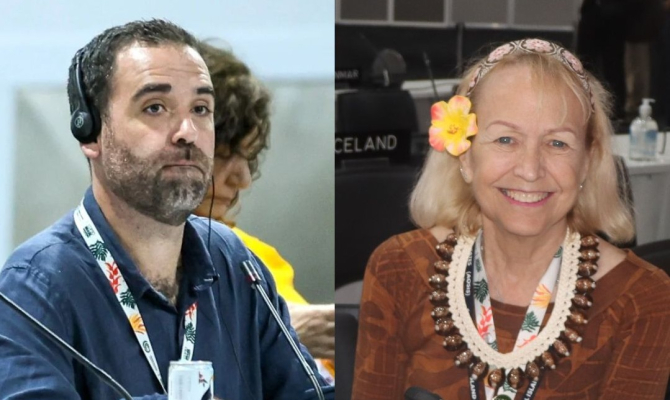
As we approach the business end of COP31 in Antalya, Mr Daniel Lund, Special Adviser to the Fijian Government, and Ms Linda Siegel, of the Cook Islands delegation, who jointly coordinate loss and damage negotiations for the Pacific Small Island Developing States (PSIDS), provide this update:
QUESTION: Can you tell us what the key asks are from the Pacific on loss and damage at COP31?
ANSWER: Our starting point is the science. The Pacific remains firm on keeping 1.5°C within reach and limiting the magnitude and duration of any overshoot. Every fraction of a degree of warming intensifies climate impacts and brings more devastating losses and damages, many of them permanent.
That is why loss and damage must be at the centre of the overshoot conversation here in Antalya. For Pacifici islands, overshoot is not a technical abstraction: it means more losses that no amount of adaptation can prevent. A credible response to overshoot must therefore include deep and rapid emissions cuts, scaled-up adaptation, and loss and damage support that matches the scale of need. The International Court of Justice Advisory Opinion has reinforced that 1.5°C is the primary temperature goal under the Paris Agreement and that States have legal obligations in respect of climate change.
In the loss and damage negotiating rooms, PSIDS have two main priorities.
First, predictable, accessible and scaled-up grant-based finance for loss and damage, through the Fund for Responding to Loss and Damage and through regional mechanisms including the Pacific Resilience Facility.
The Fund's resources fall far short of need. Under the Barbados Implementation Modalities (BIM), the Fund received 176 funding requests from 119 countries, totalling around USD 2.8 billion, against USD 342 million available: more than eight times oversubscribed.
QUESTION: How have negotiations progressed in Antalya so far?
ANSWER: On the joint annual report (JAR) of the Executive Committee of the Warsaw International Mechanism (ExCom) and the Santiago network, there has been good progress. PSIDS sought language recognising the capacity constraints SIDS and LDCs face in preparing requests for technical assistance under the Santiago network, and that language is now in the text.
The text of the draft decision on the JAR has now been agreed. It also recognises the voluntary guidelines for including information on loss and damage in biennial transparency reports (BTRs), and the terms of reference for the regular state of loss and damage report prepared by the Santiago network's Advisory Board.
The decision also highlights the need to resource the Santiago network and gives guidance on strengthening complementarity and coherence among the ExCom, the Santiago network and the Fund for Responding to Loss and Damage.
Work on guidance to the Fund for Responding to Loss and Damage is continuing on the basis of a draft text. PSIDS are engaging constructively so that the guidance helps the Fund scale up and reach the most vulnerable quickly.
QUESTION: How do you see the remaining days of COP31 playing out, and what would a positive outcome look like for the Pacific?
ANSWER: For loss and damage, the focus now shifts to the finance negotiations and the wider COP31 outcome. A positive outcome would include greater commitment from countries to fill the Fund for Responding to Loss and Damage, including support for fast-tracking its replenishment in 2027.
Just as importantly, the COP31 outcome on overshoot must recognise that every tenth of a degree above 1.5°C means more loss and damage, and that the response must include support for the communities on the frontline. For the Pacific, loss and damage cannot be an afterthought in the overshoot response. It is a test of whether the world is serious about it.
The 31st Conference of the Parties (COP31) to the UN Framework Convention on Climate Change (UNFCCC) is taking place from 9-20 November 2026 in Antalya, Türkiye.
The Pacific Islands Parties to the UNFCCC are Cook Islands, Federated States of Micronesia, Fiji, Kiribati, Republic of Marshall Islands, Republic of Naoero, Niue, Palau, Papua New Guinea, Samoa, Solomon Islands, Tonga, Tuvalu and Vanuatu.
For further information on the Pacific at COP31 please visit: www.sprep.org/cop31