

12 November 2026, Antalya - In April this year, Super Typhoon Sinlaku devastated the states of Chuuk and Yap in the Federated States of Micronesia (FSM), killing nine people and damaging homes, crops, water systems and essential infrastructure.
The super typhoon caused damages estimated at approximately USD 96 million dollars, roughly 18 percent of the FSM’s national GDP.
“For a large economy, a disaster of this scale would be a major shock,” Leaders attending COP31 in Antalya Türkiye were told. “But for a small island country, its consequences are felt in our homes, our national budgets, and our communities for years to come.”
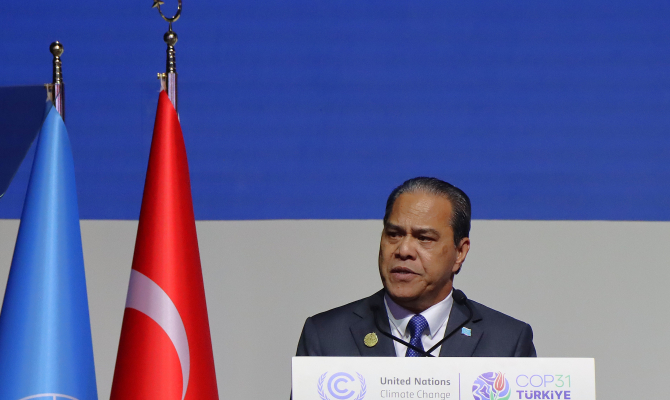
Addressing the first part of the High-Level Segment for Heads of States and Government at COP31 in Türkiye on Wednesday, the President of the Federated States of Micronesia, His Excellency Wesley W. Simina, delivered a passionate plea.
“Every fraction of a degree counts,” he said. “Every day counts. Every year counts. And the actions we take in this decade will determine the conditions under which the Pacific lives for generations to come.”
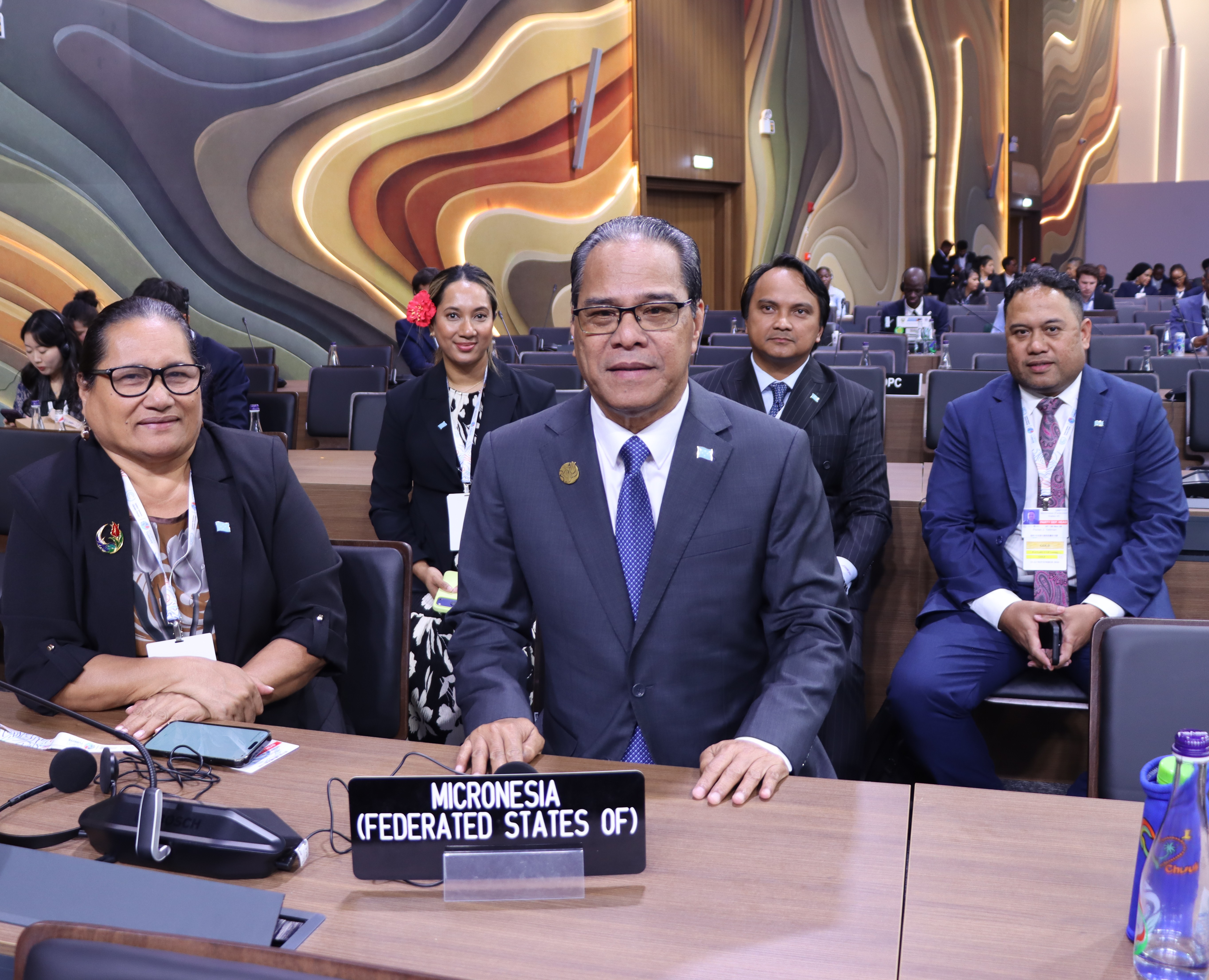
President Simina heads the FSM delegation in Türkiye where they have come to seek urgent and tangible climate actions, amplifying the One Pacific Voice on 1.5 to stay alive. They remain hopeful as negotiations get underway.
“We uphold 1.5°C as a threshold of fundamental importance for the future of island states,” he said.
“The scientific picture is increasingly grave. As the world confronts an unprecedented period of overshoot of 1.5°C, warm-water coral reefs face critical tipping thresholds and irreversible losses. For Micronesia, this has direct consequences.”
To avoid such a scenario, President Simina said its imperative decisions made at COP31 contribute to slowing the rate of warming so there is more time for adaptation and to reduce the pressure on ecosystems.
He reminded that Pacific Leaders have collectively called on all countries to address short-lived climate pollutants, particularly methane, to prevent near-term warming.
“This is a shared Pacific commitment, and Micronesia is proud to have championed it,” he said. “In an era of overshoot, rapid methane reductions, full implementation of the Kigali Amendment, greater energy efficiency and reduction in other super pollutants can help slow warming in the near term. These efforts must accompany an accelerated, just, orderly and equitable transition away from fossil fuels.”
FSM also called for just transition to protect livelihoods and leave no island community behind.
On energy transition, Micronesia continues to show leadership by efforts on renewable energy, energy efficiency and reduced dependence on imported fossil fuels.
“Our national ambitions include universal electricity access and 70% renewable electricity generation by 2030, with a further goal of 80% renewable energy power generation by 2035; targets that depend on meaningful international support,” said President Simina.
“The Pacific does not come to this conference merely to describe what we stand to lose. We come with solutions, with determination, and with a long tradition of looking after one another. We ask the international community to meet our leadership with action,” the President of FSM said.
“For Micronesia, success will be measured in practical terms: a slower rate of warming, declining global emissions, stronger resilience, more accessible finance, greater energy security and reduced risk to our people.”
The 31st Conference of the Parties (COP31) to the UN Framework Convention on Climate Change (UNFCCC) is taking place from 9-20 November 2026 in Antalya, Türkiye.
The Pacific Islands Parties to the UNFCCC are Cook Islands, Federated States of Micronesia, Fiji, Kiribati, Republic of Marshall Islands, Republic of Naoero, Niue, Palau, Papua New Guinea, Samoa, Solomon Islands, Tonga, Tuvalu and Vanuatu.
For further information on the Pacific at COP31 please visit: www.sprep.org/cop31