

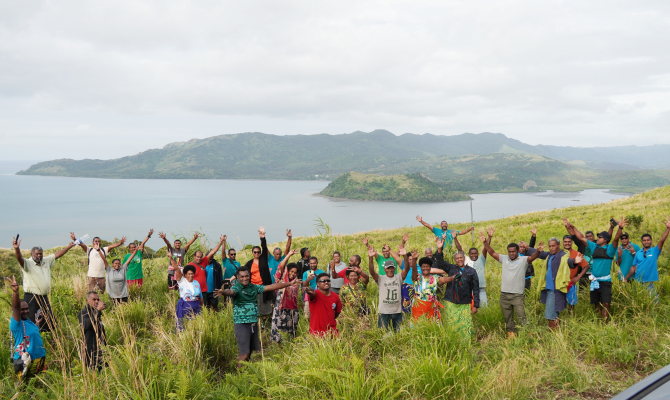
Rakiraki, Fiji — Communities from Taveuni and Ra came together in Rakiraki to share knowledge, experience, and practical approaches for restoring ecosystems and strengthening climate resilience.
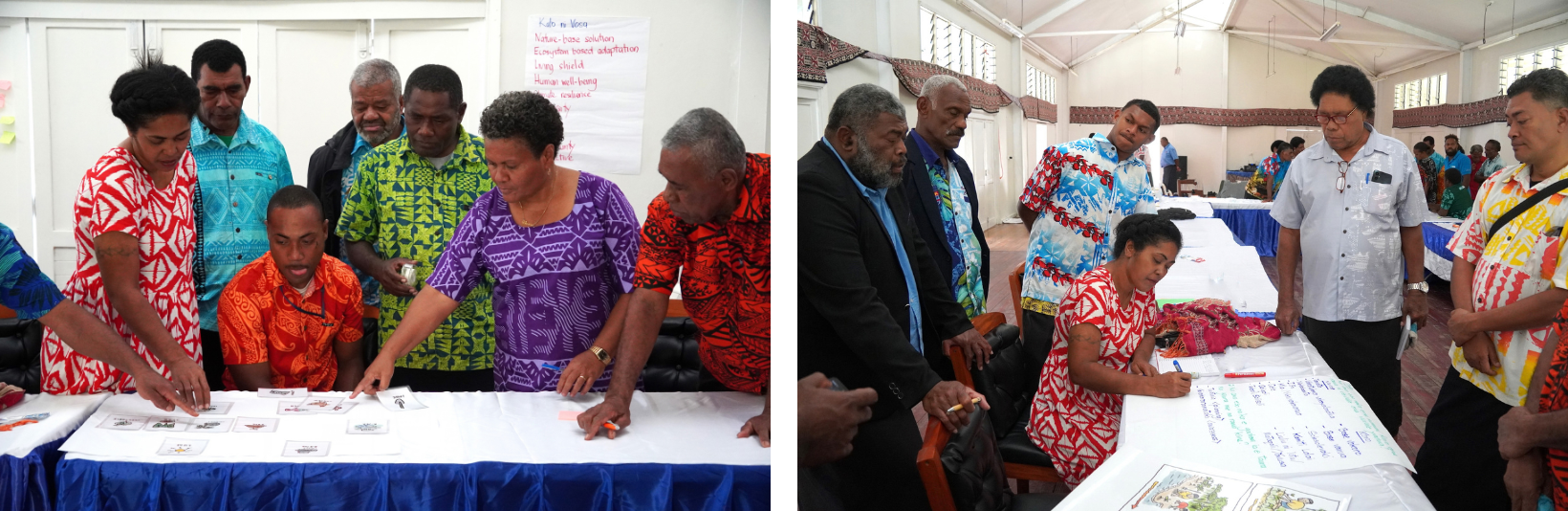
Organised through the Pacific Ecosystem-based Adaptation to Climate Change Plus (PEBACC+) Project, the learning event provided a practical platform for the 58 participants, including community representatives, farmers, women and youth representatives, traditional leaders and government officers, to exchange knowledge and experience on ecosystem restoration and Nature-based Solutions (NbS).
The learning event focused on mangrove restoration, reforestation, native tree planting, agroforestry and the connections between healthy ecosystems from ridge to reef. And at the heart of the event was peer-to-peer learning.
Participants from Taveuni had the opportunity to learn directly from communities and practitioners in Ra about restoration initiatives, while also sharing their own experience in mangrove restoration, farming and community-based resource management.
“We not only learned, but we also shared what we know and exchanged knowledge; this has been very educational,” said Rafaele Vuniwai, a Bouma representative. For participants, this created an opportunity to learn from the successes and challenges of another community facing similar environmental and climate-related issues.
Participants visited reforestation, mangrove planting and agroforestry sites in Rakiraki, where they could see restoration approaches in practice and speak directly with people involved in the work.
For Iliavi Seru, District Officer with the Ministry of Rural Development, the experience changed his perspective on how development and environmental protection can be approached. “Many times, we prioritise development and forget the importance of our environment and its protection. This learning event has changed my perspective and mindset on how we should approach development,” he said, reflecting on what he learned from the mangrove site visit.
Participants explored how activities in forests and farming areas can influence rivers, coastal ecosystems, marine life and livelihoods. Healthy forests can help retain rainfall and reduce erosion, while vegetated riverbanks can reduce sediment movement into downstream ecosystems.
For Apisai Kulataudrau, a farmer from Vuna, seeing this connection first-hand reinforced the importance of looking beyond individual ecosystems. “From the field visit, I learned about the impact of what we do uphill on our coast, the ridge-to-reef concept; it was great to learn from the people of Ra,” he said.
Rusiate Laladidi, Mata-ni-Tikina from Wainikeli, similarly highlighted the connection between forests and the coast and the importance of the ecosystems within that relationship.
The learning event also provided participants with practical approaches that could be considered and applied in their own communities.
Agroforestry was one area identified by participants as particularly relevant. By integrating trees, crops, animals and soil processes, agroforestry can support a more holistic approach to land management.
For Atonio Apole, a Vidawa community representative, the learning demonstrated the usefulness of agroforestry for land in Taveuni. “I learned about the effectiveness and usefulness of agroforestry for our land. These are lessons that I can take back and apply in Taveuni,” he said.
Participants also gained a greater appreciation of native tree planting and reforestation, including the role trees can play as windbreaks and in protecting coastal areas from strong winds and waves.
For some participants, the value of the learning event was reflected in a renewed commitment to continue restoration efforts at home.
Georgina Tawake of the Navakacoa Women’s and Youth Club said seeing the effort required to access and restore mangrove sites in Rakiraki broadened her understanding and gave her a renewed sense of purpose to expand the restoration work already underway in Taveuni. She said, “I thank SPREP for this learning event, as well as Conservation International for the field visits. What we do now will inspire others and future generations to carry on this work. It is up to us to apply all that we have learned.”
For Mikaele Tawake, Navakacoa Village Headman, the experience also reinforced the connection between his work on mangroves and the forests further inland. “I focus on mangroves back in Taveuni but here in Rakiraki, during the field visit, I decided to join the team going up to the forest, and I learned about the important link between the forest and the work that I do. I plan to take what I have learned and apply it back home.”
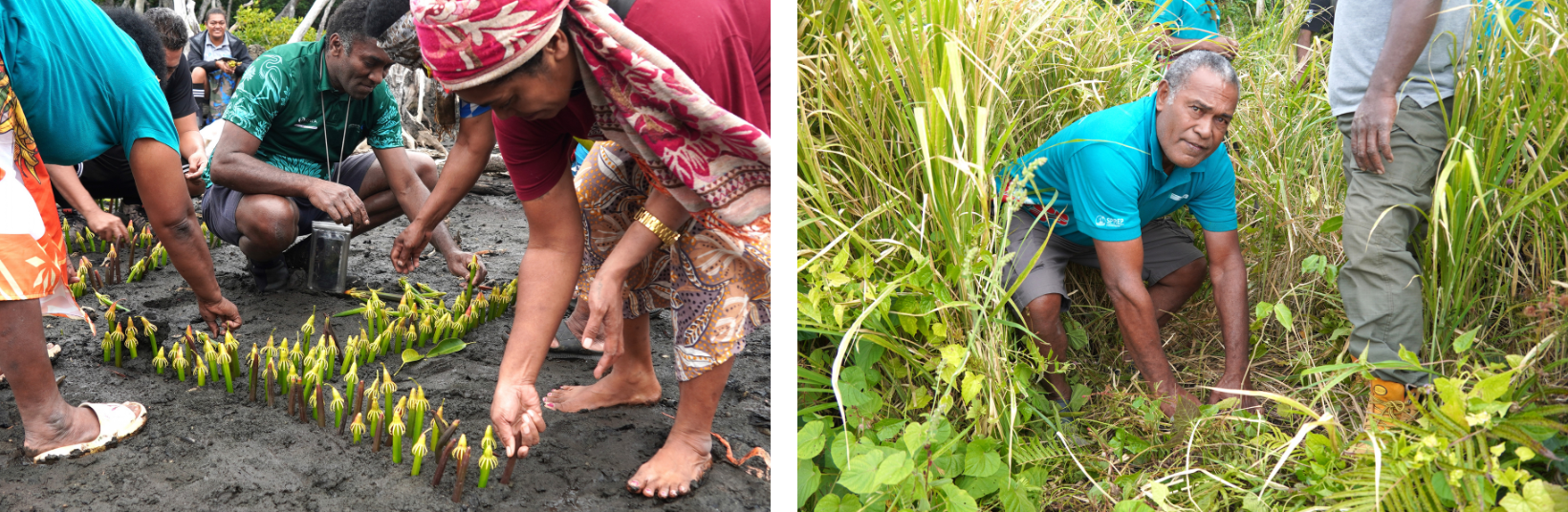
These reflections demonstrate the practical value of cross-site learning: participants were gaining new information and identifying lessons relevant to the work already taking place in their communities.
The Fiji Cross-Site EbA Learning Event that took place on 2-7 August 2026, contributes to the wider PEBACC+ focus on strengthening practical knowledge, capacity building and regional cooperation on ecosystem-based approaches to climate adaptation.
“The learning event is about bringing people together to share what is working on the ground, learn from each other’s experiences and identify approaches that can be adapted to their own communities,” said Loraini Sivo, PEBACC+ Project Manager, SPREP.
“By combining technical knowledge with practical field experience and traditional knowledge, participants were able to see the connections between healthy ecosystems, climate resilience and community livelihoods. We hope the lessons from Rakiraki will continue to inform and strengthen ecosystem-based adaptation efforts in Taveuni and other communities across Fiji.”
The PEBACC+ Project is implemented by the Secretariat of the Pacific Regional Environment Programme (SPREP), with support from the Kiwa Initiative and the French Facility for Global Environment (FFEM).
---
For more information, please contact: Setaita Tavanabola, Communications Officer, PEBACC+ Project, SPREP; email: setaitat@sprep.org or visit www.sprep.org/pebacc-plus