

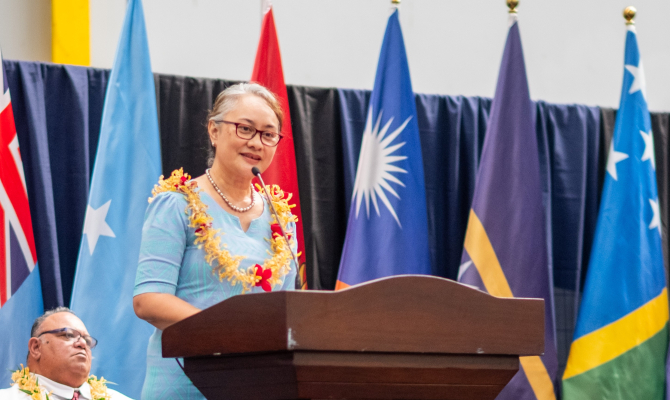
Talofa lava, Halo and warm Pacific greetings,
On behalf of SPREP, I wish you a warm welcome to the 5th Pacific Ocean Pacific Climate Change Conference (5POPCCC). SPREP is pleased to collaborate with the Solomon Islands National University (SINU), Victoria University of Wellington (VUW), and the National University of Samoa in co-hosting this fifth POPCCC here in the Solomon Islands
The Pacific Oceans Pacific Climate Change Conference (POPCCC) is a Pacific-owned, Pacific-led event organized to provide an informative and collaborative Pacific research platform for academics, researchers, climate change practitioners, private sector, civil society, and students to share their research findings with Pacific based and global researchers.
Previous editions of this conference were hosted in Wellington, New Zealand (2016 and 2018), online in 2020 and most recently held in Apia, Samoa in 2024. The Pacific Oceans Climate Change Conference is a multi-disciplinary conference, bringing together experts from the private, public, and civil society, and a variety of participants from the arts, faith communities, industry, and other backgrounds to look at ways where, together, we can all play our part to address climate change. The conference is a platform to examine the persistent challenges faced by Pacific Island countries in developing and improving adaptation strategies and ensuring easier access to finance.
The theme for this year’s POPCCC is “Amplifying One Pacific Voice for Action on 1.5 ºC to Stay Alive”. The Pacific is the world’s largest ocean, covering nearly one-third of the Earth’s surface and home to many of the world’s marine species and supports Pacific Island ecosystems, traditions, and culture. It is our region’s largest resource, and it defines us as Pacific people, underpinning our livelihoods and way of life.
However, as again reaffirmed in the recent 55th Pacific Islands Forum (PIF) Leaders' meeting held in Palau in the beginning of this month, climate change remains the single greatest threat to our oceans, our security, livelihoods, and wellbeing of Pacific peoples, underscoring the urgency of ambitious global action consistent with the best available science.
Therefore, it is a most fitting theme for this week’s proceedings and discussions to once again band together as a region with a united Pacific voice and call for concrete actions and commitment through this platform and this meeting to strengthen the collective Pacific voice in demanding immediate global action on the 1.5 °C climate threshold.
As we build towards COP31 in November of this year, let this be another space and opportunity to play our part in supporting the implementation of the COP31 Pacific Partnership and the work of the Pacific COP31 Envoys to advance regional priorities across the strategic pillars of keeping 1.5°C within reach, enhancing access to climate finance, elevating the ocean-climate nexus, and amplifying Pacific voices and leadership.
SPREP shares mutual interests with our partners in relation to climate change resilience, environmental protection, and strengthening the systems, institutions, organisations, and individuals concerned with these issues. Our programmes address major issues for Pacific Island countries and territories, including climate change resilience, ecosystem and biodiversity protection, waste management and pollution control, and environmental governance. We also host the Pacific Climate Change Centre, which has four mutually reinforcing functions: knowledge brokerage, capacity building, innovation, and research.
We are at a crucial stage to enact change with the Synthesis of the IPCC’s Sixth Assessment Cycle for climate action. It highlights an escalating global issue where climate change threatens human health, development goals, and the environment on which we depend.
I would also like to reiterate the important role that science plays in informing the climate process, especially in relation to oceans and climate change, providing critical evidence and facts to build the case for climate action and the urgency of implementation. In the Pacific, we need science-based solutions from scientific research to help move assessments and plans into implementations that will leave no one behind.
I would like to acknowledge the Pacific Academy of Sciences, our Pacific governments, applied research institutions, the Government of New Zealand through the Ministry of Foreign Affairs and Trade, the Government of Australia through the Department of Climate Change, Energy, the Environment and Water (DCCEEW) and the Department of Foreign Affairs and Trade (DFAT), the United Kingdom, UN agencies, civil society, the private sector and friends of the Pacific who have supported this initiative through financial contributions and support shared in kind.
Finally, I would like to congratulate the leadership of our generous host, the Government of the Solomon Islands along with our co-hosts – the Solomon Islands National University (SINU), Victoria University of Wellington, and the National University of Samoa (NUS), the organizing committee and all who have worked tirelessly behind the scenes to make this event a success. I commend you all.
We look forward to having a talanoa on Pacific climate change issues and developing concrete actions and ways that we can assist in building the resilience of our Pacific Island region for a prosperous Blue Pacific Continent and keeping 1.5 alive.
I wish everyone a successful event and hope you will find it productive and useful.
Fa'afetai tele lava, tankiu tumas, and thank you.