

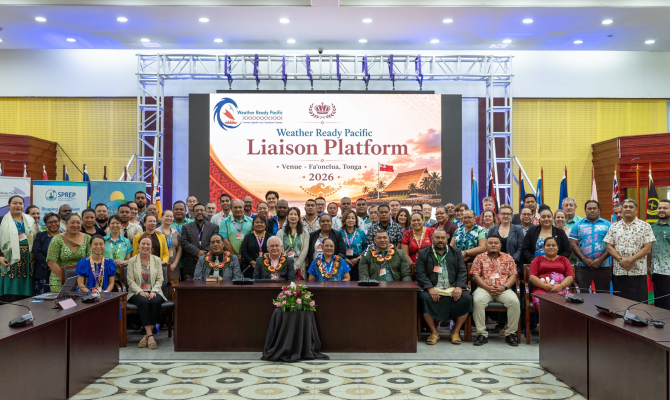
9 September 2026, Nukuʻalofa, Tonga - Pacific governments, regional organisations, development partners and technical agencies came together in Nukuʻalofa for the inaugural Weather Ready Pacific Liaison Platform, marking an important step towards stronger coordination and sustainable investment in Multi-Hazard Early Warning Systems (MHEWS) across the Pacific.
Held from 8 to 9 September 2026 under the theme “From Warning to Action: Partnering for a Prepared and Sustainable Pacific,” the Platform brought together partners supporting weather, climate, water, ocean and multi-hazard early warning services. The theme reflects the Platform’s focus on turning forecasts and warnings into timely action, while building partnerships capable of sustaining Pacific early warning systems over the long term.
The Platform strengthened coordination around nationally identified priorities and the Pacific-led Weather Ready Pacific (WRP) Programme, providing a forum for countries, regional organisations, technical agencies and development partners to align their support and identify practical solutions to persistent challenges.
Participants recognised the progress made in strengthening early warning systems across the Pacific, while highlighting long-term sustainability as a major challenge. Infrastructure maintenance can account for up to 70 per cent of full life-cycle costs, yet maintenance and replacement are consistently underfunded.
The Platform agreed that this financing gap cannot be addressed through any single funding source. Participants also supported progressing a Pacific Hydro-Met MHEWS Sustainable Maintenance Facility as one component of a broader financing mix to protect investments, extend the life of critical infrastructure and sustain operational early warning services.
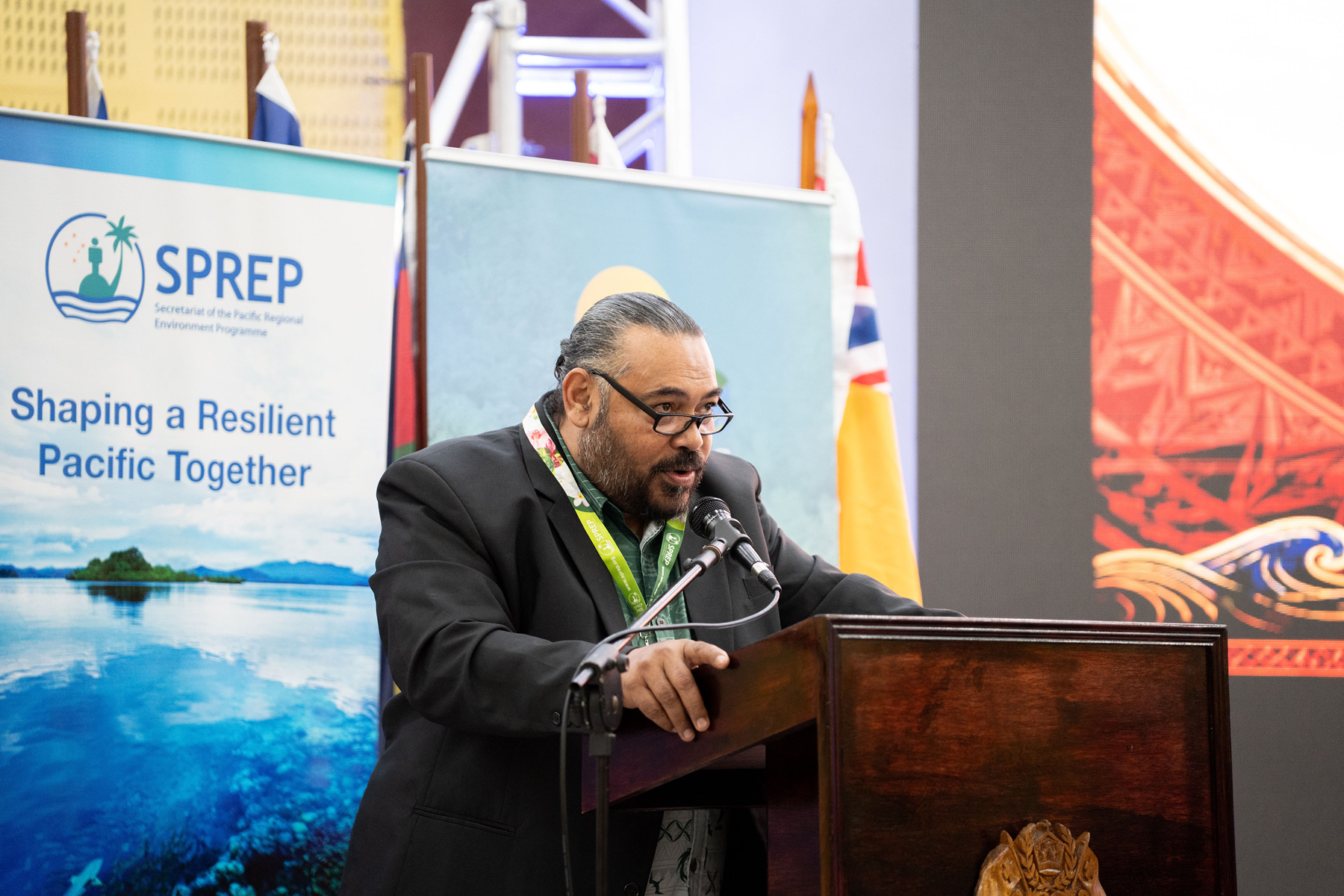
"Since 1980, we have lost one long-term climate data record in the Pacific every two years. That is not just a problem, it is a crisis. If we do not have quality data, we will never have quality warning services. It is both alarming and urgent," said Mr Ofa Fa’anunu, Programme Manager of WRP. "The Pacific has endorsed the continuation of the design of a sustainable maintenance facility for Pacific hydrometeorological and multi-hazard early warning systems (MHEWS)."
The Platform also called for future investments to be anchored in a single Pacific-owned infrastructure pipeline, built from nationally identified priorities and coordinated regionally through the leaders-endorsed Weather Ready Pacific Programme. Investments should be financed across their full life cycle and measured by the sustainable capability they leave behind.
Participants emphasised that relatively modest investment in hydro-meteorological and early warning systems can deliver catalytic benefits for lives, livelihoods, resilience and economic development, including stronger disaster preparedness, aviation and maritime safety, food and water security, and resilient infrastructure.
The meeting also strengthened the regional approach to Early Warnings for All (EW4All) and considered closer integration of risk information, hazard preparedness and anticipatory action into the Weather Ready Pacific architecture.
The inaugural Liaison Platform signals a shift from fragmented interventions towards a more coordinated, Pacific-led model in which countries identify priorities, regional mechanisms support coordination, and partners align technical and financial assistance behind a shared regional direction.
The outcomes of the Platform will inform discussions of the Pacific Meteorological Council and the Fourth Pacific Ministerial Meeting on Meteorology (PMMM-4) in Nukuʻalofa.
Pacific early warning systems must not only be built, they must be maintained, financed and sustained for generations to come.
The Pacific Meteorological Council is a specialised subsidiary body of the Secretariat of the Pacific Regional Environment Programme (SPREP) established to facilitate and coordinate the scientific and technical programme and activities of Pacific National Meteorological and Hydrological Services.
The eighth meeting of the Pacific Meteorological Council (PMC-8) is held from 10 – 14 September 2026 in Nuku’alofa, Tonga. It follows a series of pre-meetings which starts on 7 September 2026 and will conclude with the convening of the fourth Pacific Ministerial Meeting on Meteorology (PMMM-4) on 16 September 2026.
The PMC-8 and PMMM-4 are made possible through the partnership and collaboration between the Government of Tonga, SPREP, World Meteorological Organization-Climate Risk and Early Warning Systems (WMO-CREWS) project, United Kingdom-Weather and Climate Information Systems (UK-WISER), Australian Department of Foreign Affairs and Trade (DFAT), New Zealand Ministry of Foreign Affairs and Trade (MFAT), Weather Ready Pacific Programme (WRPP), European Union-funded Intra-ACP Climate Services and Applications programme (ClimSA), Climate and Oceans Support Program in the Pacific (COSPPac), Republic of Korea-Pacific Islands Climate Prediction Services Phase 3 project (ROK-PI CliPS 3), Apec Climate Centre (APCC), and the Pacific Community (SPC).