

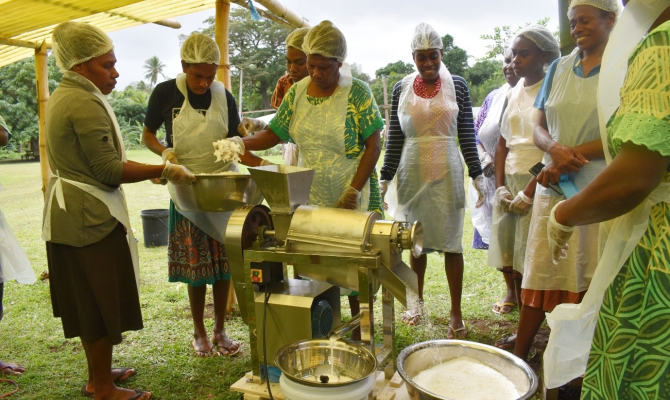
Tanna Island, Vanuatu – Coastal communities in Vanuatu are gaining practical skills to turn locally available coconuts into a potential source of household income, following a four-day Virgin Coconut Oil production training held in Port Resolution and Lenakel.
The training, held from 20–24 July 2026, brought together 52 participants, including 33 women, eight men and 11 young women, from Lamkail in West Tanna, Iakupen, Ianawefa, Vatarata, Samua and Ienkahi. The activity was supported through the Pacific Ecosystem-based Adaptation to Climate Change (PEBACC+) project, in partnership with the Vanuatu Department of Commerce, Trade, Tourism and Industries.
The training is part of planned activities for Port Resolution and Lenakel, where coastal communities have committed their coastlines to marine conservation. Virgin Coconut Oil production is being promoted as an alternative livelihood option while communities reduce or close access to coastal fisheries for conservation purposes.
The virgin coconut oil extraction training on Tanna is well placed because the island has abundant coconut resources, with smallholder coconut farmers forming the backbone of local supply. By combining their coconuts, labour, and knowledge, farmers can achieve the volume and consistency needed to develop virgin coconut oil production into a viable, community-led business rather than a scattered subsistence activity.
For participants, the training provided an opportunity to move beyond traditional, manual production methods and learn how to use specialised equipment to improve the processing of coconut into oil.
At Port Resolution, participant Jocelyn Namaka said the training had provided the practical knowledge and equipment needed to take their previous efforts further.
“We have attempted virgin coconut oil production before but without proper training from the Department of Industries and the process was slow as it was all manual. We believe that with proper training that we have now received together with the machines given to us, we can go one step further with this initiative.”
Participants were trained in operating the coconut grinding and oil extraction machines, with women actively involved in processing coconut, extracting coconut milk, and producing the finished virgin coconut oil. The final product produced by participants at Lamkail was bottled for potential sale.
The immediate market response was also encouraging. Samples of the virgin coconut oil produced during the training were sold out on the day, providing an early indication of local demand for the product.
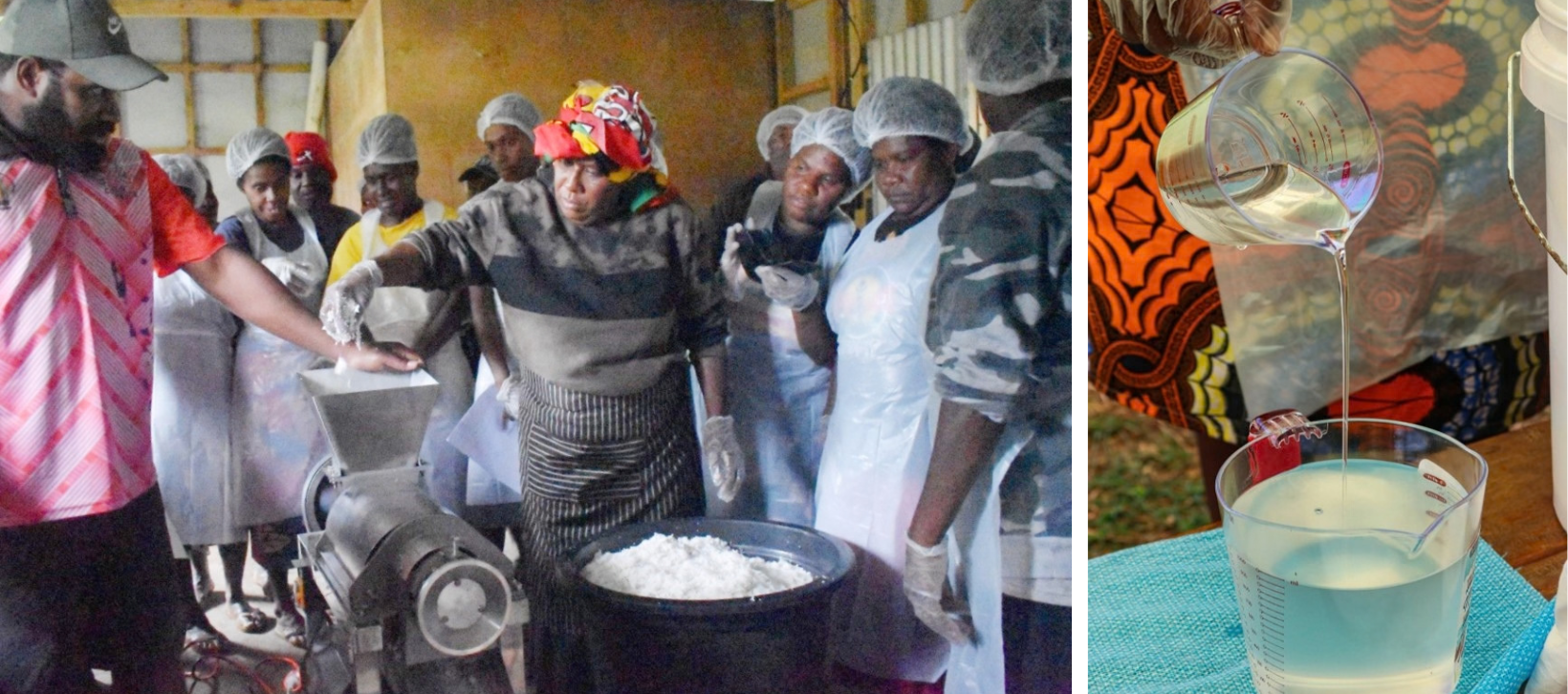
and (right) freshly distilled virgin coconut oil. Photo: SPREP
For William Bani, PEBACC+ Project Country Coordinator with the Secretariat of the Pacific Regional Environment Programme (SPREP), the initiative is directly connected to the communities’ conservation commitments.
“The PEBACC+ project supports this initiative because the communities have committed themselves to conserving their fisheries resources; hence, we believe this will contribute to assisting their households with income, which would have otherwise been gained from the sale of marine resources.”
The training also generated strong interest among participating women, who expressed appreciation for the production equipment and the opportunity to develop their skills. Participants have committed to pursuing virgin coconut oil production in the coming months.
By linking marine conservation with alternative livelihood opportunities, the initiative demonstrates how communities can continue to generate income while supporting the protection and sustainable management of their coastal resources.
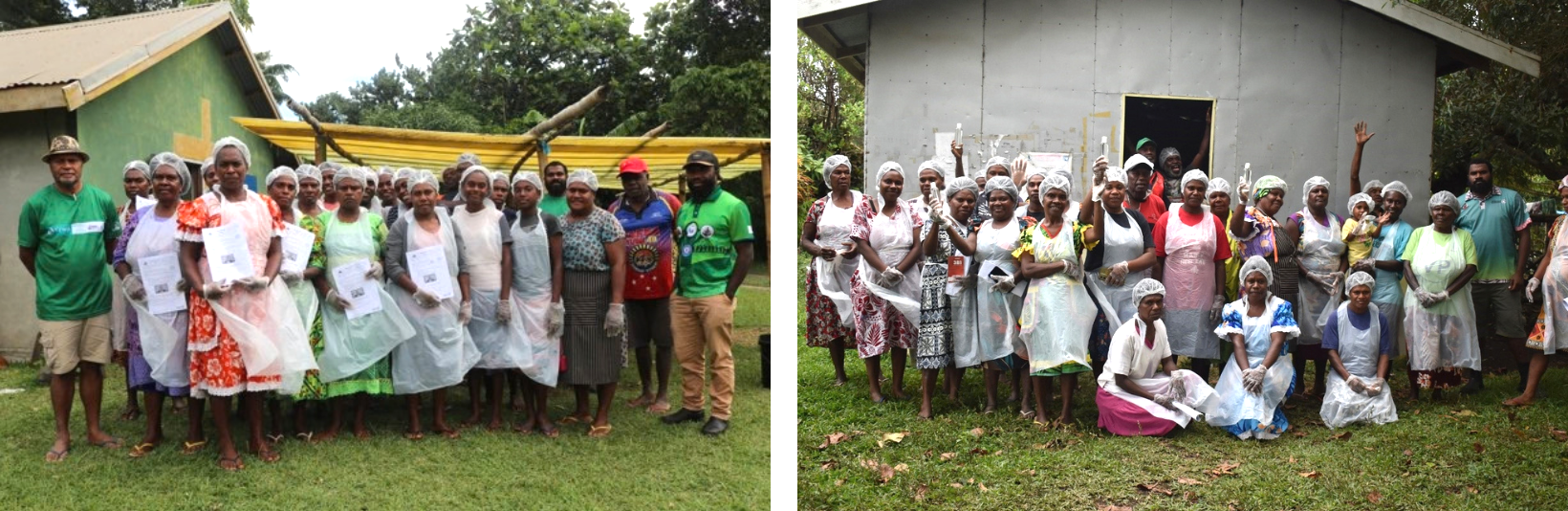
For communities in Port Resolution and Lenakel, the training has provided technical knowledge and equipped local producers with machinery, practical skills, and an initial indication of market demand, creating a foundation for virgin coconut oil production as an additional source of household income alongside their conservation efforts.
PEBACC+ is a regional project implemented by SPREP and funded by the Kiwa Initiative through its donors, the European Union, Agence Française de Développement (AFD), Global Affairs Canada, Australian Government Department of Foreign Affairs and Trade (DFAT), and New Zealand Ministry of Foreign Affairs and Trade (MFAT), with co-financing from the French Facility for Global Environment (FFEM).
For more information, please contact: Setaita Tavanabola, Communications Officer, PEBACC+ Project, SPREP; email: setaitat@sprep.org or visit www.sprep.org/pebacc-plus