

Honourable Ministers, Excellencies, honoured guests, conference delegates, partners, sponsors, colleagues, and friends.
As we bring the 11th Pacific Islands Conference on Nature Conservation and Protected Areas to a close, we do so with deep gratitude, renewed purpose, and a shared responsibility to carry the work forward.
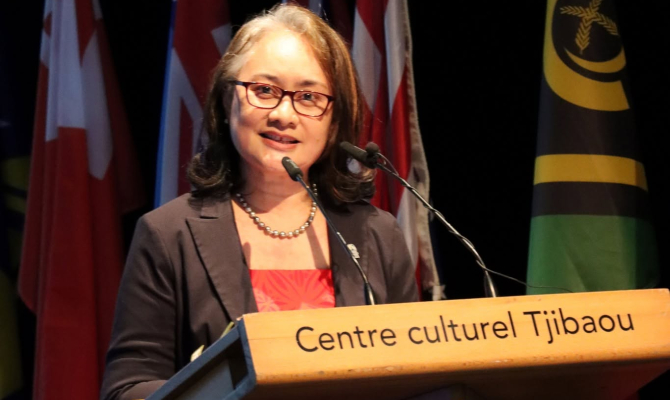
For four days, we have gathered here at the Jean-Marie Tjibaou Cultural Centre as one Pacific community.
Through talanoa, we have shared knowledge, engaged in difficult conversations, celebrated progress, and strengthened the relationships that make collective action possible.
We are deeply grateful for the privilege of meeting here, and for the warm welcome and hospitality extended to us by the host government of New Caledonia and government of France.
Honourable Minister Wamyton, SPREP deeply appreciates your steadfast commitment to Pacific conservation and the generous support of the Government of New Caledonia. Your leadership, together with your team’s dedication, ensured the successful hosting of the 11th Pacific Islands Conference on Nature Conservation and Protected Areas in Nouméa and created a welcoming setting for Pacific dialogue and collective action.
Thank you to the Director and staff of the Cultural Centre for creating an environment worthy of the conversations, reflections, and commitments that have shaped this Conference.
We are also grateful to the support of the Pacific Islands Round Table for Nature Conservation and the Working Groups. To our donor partners the Governments of New Zealand, and the United Kingdom; the European Union; Pacific Bioscapes; the NBSAP Accelerator Partnership; PRISMSS Restoring Island Resilience; IUCN; WWF; Vision; Kanak de l’Ocean; OFB; Pew Charitable Trusts; the Bezos Earth Fund; KIWA; Live and Learn Environmental Education; GIZ Pacific; the Waitt Institute; and Ocean 5 – we say thank you.
For 51 years, this Conference has brought together the voices, knowledge, and leadership of the Pacific conservation community.
Across our ocean of islands, it has helped us build a shared course.
This 11th Conference has been especially significant, as we have met in person to confront the interconnected challenges of biodiversity loss, climate change, and pollution— and their immense impacts on nature, cultures, communities, and economies of the Pacific.
Yet throughout this gathering, we have heard powerful inspiring stories: of communities restoring their environments; customary custodians sustaining knowledge and stewardship; young people bringing energy and ideas; and governments and partners working together with determination.
These are reasons for hope— and foundations on which we must build.
Our call to Remember, Recognise, Reset, and Reimagine gives us a clear direction.
Remember the wisdom of our ancestors and the responsibilities handed down to us.
Recognise the courage of our communities, the leadership already present within them, and the urgency of the challenges they face.
Reset the ways we work, so that partnerships are stronger, resources reach those doing the work, and commitments resulting in meaningful change.
Reimagine a Pacific future where nature, culture, and people thrive together— and take the practical steps that will bring that future within reach.
The vision first endorsed at the seventh nature conference in Rarotonga in 2002 remains our compass.
As we enter the remaining years of that 30-year conservation ambition, we must ask ourselves:
What will our communities experience differently because of the decisions we have made here?
The answer must be visible in healthier reefs, recovering forests, protected species, resilient ecosystems, stronger livelihoods, and communities adequately resourced to care for their lands and waters.
Across our thematic streams— from People, Nature, and Culture to nature-based solutions, area-based conservation, invasive species management, species conservation, environmental law, and sustainable nature finance— we have heard a consistent message:
Pacific leadership must shape Pacific conservation.
Our communities must help determine priorities, lead implementation, and share in the benefits.
Our traditional knowledge and scientific evidence must inform one another.
Our young people must have a meaningful voice in decisions today; alongside the elders whose knowledge connects generations.
This Conference has given us important tools for that work.
The Pacific Islands State of Environment and Conservation Report 2026 strengthen our understanding of the condition of our environment, the pressures it faces, and the responses required. Its value will be realised through the decisions it informs and the action it inspires.
The Pacific Islands Framework for Nature Conservation 2026–2030 sets our shared regional direction. It brings global biodiversity commitments into a Pacific context, supporting national action and connecting the Kunming–Montreal Global Biodiversity Framework with our aspirations under the 2050 Strategy for the Blue Pacific Continent.
Through the Môo Mâ Awé Declaration, we renew our commitments to protect and restore nature, uphold Pacific knowledge and cultures, and ensure that conservation supports the wellbeing of present and future generations.
Together, these outcomes give us evidence, direction, and a shared commitment.
As we carry a unified Pacific voice to CBD COP17 in Armenia, as well as UNFCCC COP31 in Türkiye, let us speak with the confidence of a region that brings knowledge, experience, and solutions to the world.
Let us carry the priorities of our Pacific communities into those discussions— and sustain that resolve throughout the next five years.
The work does not end here. It continues when we return home.
Let us return ready to turn our commitments into practical action.
Let us strengthen the partnerships formed here, nurture the friendships we’ve forged, support community leadership, invest in our young people, and sustain the knowledge systems that have guided stewardship throughout generations.
Across the Pacific, we understand that a voyage depends on shared effort.
Our ancestors read the stars and crossed vast oceans with courage, knowledge, and trust in one another.
May we carry that same spirit forward: to remember the wisdom and stewardship that have brought us here; to recognise the urgency and scale of the challenges before us; to reset our efforts where change is needed; and to reimagine a future in which Pacific nature, cultures, and communities thrive together.
On behalf of SPREP and the Conference organisers, I thank you for your valuable contributions. Your experience has grounded our discussions. Your openness has strengthened our understanding. Your commitment will carry forward the outcomes of this Conference with urgency, determination, and courage.
With those closing remarks, I wish you safe travels home and renewed strength for the work ahead.
Merci beaucoup. Thank you.