

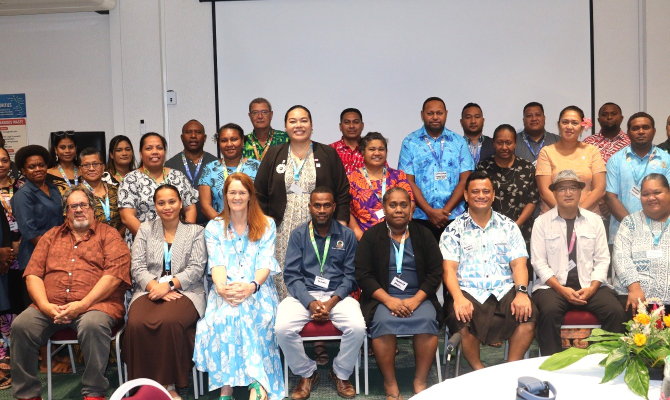
15 September 2026, Port Vila – Waste and climate change focal points from 14 Pacific Small Island Developing States gathered in Port Vila this week for a two-day workshop to determine the focus areas of Component 4 of the Regional Programmatic Approach to Climate Action (RPACA).
Hosted by the Secretariat of the Pacific Regional Environment Programme (SPREP) on 14–15 September, the workshop brought member country participants (representing climate change and waste management and pollution agencies) together to prioritise waste and pollution interventions with a clear climate rationale, identify what is best delivered at the regional and national levels, and begin shaping the funding proposal that SPREP will progress to the Green Climate Fund (GCF).
RPACA is a country-led, long-term approach to securing climate finance at scale for the Pacific. Co-chaired and driven by the Cook Islands and Palau, it is delivered in partnership by the Asian Development Bank (ADB), SPREP and the Pacific Community (SPC) as accredited entities to the GCF. SPREP leads Component 4, which covers pollution and waste management together with knowledge sharing, communication and coordination across the programme.
Vanuatu's Director of Environment, Mr Osbourne Melenamu, said waste could no longer be treated separately from climate change.
"Waste is not only an environmental and public health challenge; it is also a climate challenge," Mr Melenamu said. "Every tonne of waste avoided, reused, recycled, or properly managed contributes not only to healthier communities but also to reduced emissions and stronger climate outcomes."
"This is not simply about managing waste better. It is about strengthening livelihoods, protecting our oceans and ecosystems, reducing greenhouse gas emissions, and building a more resilient Pacific for future generations."
Over the two days, countries validated the mapping of their waste priorities against national climate commitments, and worked collaboratively to agree on the climate-waste problem being addressed under Component 4; and potential solutions to address this.
RPACA Co-Chair Mr Wayne King of the Cook Islands encouraged countries to use the consultation to shape a programme that reflects their priorities and gives them the time to build their own capacity to deliver.
SPREP Director of Waste Management and Pollution Control, Mr Anthony Talouli, said the workshop was an opportunity to demonstrate clearer links between waste, pollution and climate outcomes, and to shape priorities that benefit Pacific communities and future generations.
Waste focal points will remain in Port Vila for a further three days of discussions on circular economy initiatives, in partnership between SPREP and ADB.
For further information, contact: Timoci Nakalevu, Climate Change Adaptation Officer, SPREP timocin@sprep.org