

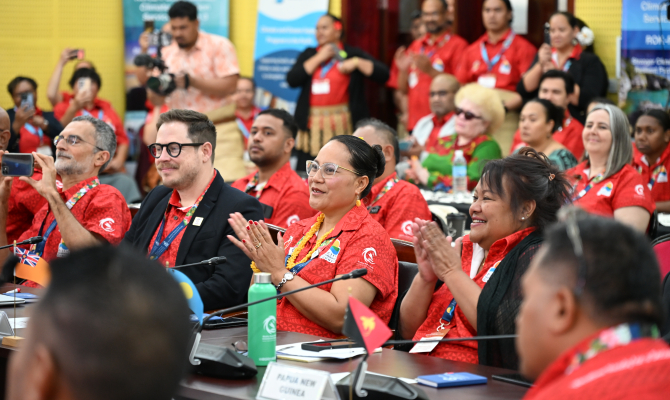
The Pacific Meteorological Council (PMC) strongly acknowledged the contributions of the Climate and Oceans Support Programme in the Pacific (COSPPac), emphasising the programme’s critical role in strengthening national meteorological services, improving access to climate information and supporting communities across the region.
During discussions at the eighth Pacific Meteorological Council (PMC-8) meeting in Tonga, representatives from Pacific island countries and territories expressed their appreciation for COSPPac’s longstanding support since 2012, and called for its continuation beyond June 2027, which is when the current phase is scheduled to end.
The discussions came at a critical time for the Pacific, as countries navigate the impacts of El Niño and increasingly complex weather and climate challenges. Members highlighted the importance of maintaining access to COSPPac’s climate data, technical expertise, capacity development and communications support, particularly when reliable climate science information is essential for preparedness and decision-making.
Director of the Republic of the Marshall Islands’ (RMI) Weather Service Office, Mr. Reginald White, described COSPPac as a key contributor to the country’s meteorological services, emphasising the importance of equitable support and resource distribution across National Meteorological and Hydrological Services (NMHS).

Other members echoed this sentiment, recognising COSPPac’s contribution to building national capacity and strengthening the delivery of climate services to communities, as well as integrating traditional knowledge into climate and weather forecasts and outlooks to build resilience.
Mr. Tauala Katea, Director of Tuvalu Meteorological Services, acknowledged the programme’s role in advancing NMHS capabilities and bridging gaps between technical information and the communities that need it most, including reaching people at the last mile.
Kiribati Meteorological Services Director, Mr. Ueneta Toorua, also highlighted the value of COSPPac’s data and services in strengthening national service delivery and raising the visibility of meteorological work, while calling for additional tide gauges to support the country’s needs.
COSPPac’s support for tide gauges to enable sea-level monitoring, tsunami preparedness, and the development of tide calendars used by local communities was also acknowledged by the Cook Islands, with Niue welcoming the news of tide gauge support provided for Tokelau, reflecting the wider regional benefits of the programme.
The programme’s capacity development support, particularly during El Niño events, was emphasised by the Federated States of Micronesia as being particularly important, and a support service that is much appreciated by NMHSs in the region.

Tonga and Vanuatu also echoed this sentiment, emphasising the importance of the work being done by COSPPac to develop ENSO Directive in the region that will improve coordination between national stakeholders and provide a framework for collaboration during El Niño and La Niña events.
Beyond technical climate services, PMC members also highlighted COSPPac’s investment in communications as an important part of ensuring climate information reaches the people who need it.
The programme’s support for communications officers, software, training and workshops has helped strengthen the ability of NMHS to communicate complex weather and climate information in accessible and meaningful ways.
Mr. Laitia Fifita, Director of the Tonga Meteorological Service and Chair of the PMC, acknowledged the value of including communications officers in the programme’s support, which has allowed for Tonga Meteorological Service to employ its first Science Communications Officer.
COSPPac’s support also extends to Land and Survey services, with members noting its distinctive role as a regional programme supporting both meteorological and land-related services. Flexible funding has further helped respond to the needs of NMHS and Land and Survey agencies, allowing support to address country-specific priorities.
The programme’s scientific contribution was also recognised, including the use and citation of COSPPac-supported data and work in assessments by the Intergovernmental Panel on Climate Change (IPCC), reinforcing the importance of sustained regional climate observations and information.

While members expressed strong support for COSPPac’s work, the programme’s future beyond June 2027 remained a key concern throughout the discussions.
Mr. Fifita reflected on the programme’s far-reaching impact across the Pacific, describing it as a transformative initiative that has touched lives across communities, including women and children.
“It warms the heart to see how COSPPac has touched lives everywhere possible,” the Chair said, emphasising the importance of maintaining the progress achieved through the programme.
“We have seen the light now through COSPPac. Don’t turn that light off,” he concluded.
Niue, Papua New Guinea, and Samoa also strongly supported the call for COSPPac to continue beyond June 2027, recognising the important support rendered by the programme to Pacific climate services.
The Siu-i-Alaimoana-Ki-Likutapu Ministerial Declaration also called for development partners to to sustain and strengthen Pacific-led climate services, with Pacific Ministers for Meteorology emphasising the importance of supporting programmes such as COSPPac which are aligned with priorities identified by Pacific NMHSs and ensure that climate science translate into practical actions that strengthen resilience, security, and sustainability of the Blue Pacific continent.
COSPPac is currently in its third phase, and is delivered through a partnership between the Secretariat of the Pacific Regional Environment Programme (SPREP), Australian Bureau of Meteorology, Earth Sciences New Zealand, Geoscience Australia, and the Pacific Community (SPC).
For more information, please contact Mr. Salesa Nihmei, Director of SPREP’s Climate Science and Information programme, at salesan@sprep.org.