

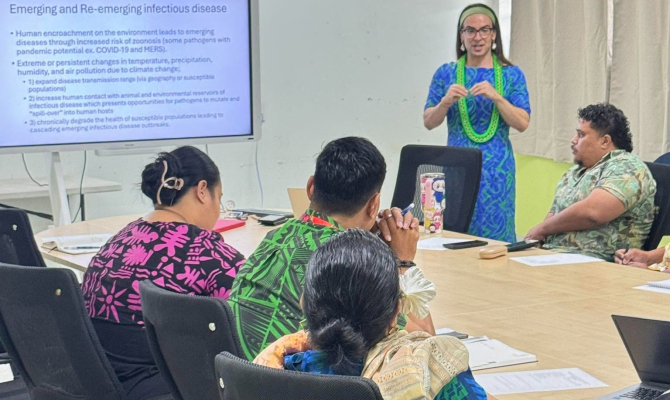
15 October 2026, Apia - Key stakeholders of the PAVE-Health project gathered in Samoa to collate global and regional evidence, increase local awareness, and outline strategic pathways to combat the growing public health threats driven by climate change.
Hosted by the Ministry of Health (MOH) on 8 October at the Public Health Conference Room, the Climate and Health Evidence Overview Seminar was attended by representatives from the MOH, Ministry of Natural Resources and Environment (MNRE), the Scientific Research Organisation of Samoa (SROS) and the National University of Samoa (NUS).
The seminar spotlighted some key findings from an initial scoping review led by PAVE-funded researcher and the Epidemiologist for Samoa, Ms Robert Carney.
“Climate change and climate conditions have both direct and indirect effects on infectious diseases and human health,” said Ms Carney.
The review highlighted critical climate-health intersections relevant to the region, including, Vector-Borne and Zoonotic Pathogens as a result of rising temperatures, shifting precipitation patterns, and extreme humidity accelerate vector breeding and shorten incubation periods for high-risk diseases like dengue, Zika, and chikungunya.
Ecological alterations are also driving the emergence of new zoonotic strains, such as highly climate-sensitive leptospirosis.

The review also highlighted water, food, and parasitic threats arising from flooding events, warming sea surfaces, and extreme El Niño patterns directly contaminate essential food and water resources, resulting in spikes of gastroenteritis and enteric pathogens. The review also evaluated ongoing challenges regarding mosquito-borne parasitic infections like lymphatic filariasis.
Added Ms Carney: “Research within Pacific Island countries and in Samoa are limited, but existing studies indicate that climate change can drive and worsen epidemics as well as pandemics. Opportunities to generate evidence exist with unanswered questions of disease transmission pathways, the effectiveness of interventions and strategies, and finding pathways for resilience.”
It also found cascading health system impacts which go beyond direct infections and include climate emergencies damaging health infrastructure, disrupting essential services like routine immunisation and screening, driving mental health distress, and exacerbating socio-economic inequalities, including documented links between disasters and heightened rates of domestic violence.
To communicate these cascading risks, the seminar mapped out concrete next steps for Samoa's epidemiological and public health surveillance systems.
Priority actions established include advancing integrated, multi-pathogen sero-prevalence surveys, enhancing early-warning syndromic surveillance platforms, and standardizing local weather datasets with health informatics to create predictive outbreak models.
“As stakeholders in the PAVE-Health project, we are committed to supporting the Ministry of Health through relevant research that strengthens the understanding of the links between climate change and health. One practical starting point may be to build on existing regional research and evidence, while adapting it to our national context and priorities,” said Ms Annie Tuisuga, of SROS.
Stakeholders emphasised integrating Gender, Equity, and Social Inclusion (GEDSI) principles directly into research designs to ensure future interventions explicitly protect Samoa's most vulnerable and underserved sub-populations.
Dr. Leiataualesa Eric Tuia of the Samoa Ministry of Health said, the seminar marks a foundational milestone, equipping PAVE project participants with the baseline insights necessary to roll out upcoming country-level research activities, optimise national notifiable disease control protocols, and safeguard the health of the Samoan people against an unpredictable climate future.
About the PAVE Project:
The Secretariat for the Pacific Regional Environment Programme (SPREP) in partnership with the University of Melbourne are delivering the Project “PAVE – Climate Change and Health: Pacific Action to enhance the Visibility of Evidence on Health and Climate Impacts” in Federated States of Micronesia, Kiribati, Samoa and Solomon Islands.
It is a 3-year project (2025 -2028) funded by Wellcome Trust that will address resource and data shortages by Generating evidence on local climate-related health risks and impacts to address existing data and policy gaps through Work Package 3; making this evidence available for use by the health sector to access climate finance and advocate for policy action to address climate-related health impacts through work package 2 and demonstrating the feasibility and effectiveness of a co-designed capacity-building program to build sustainable capabilities in the Pacific through work package 1.