

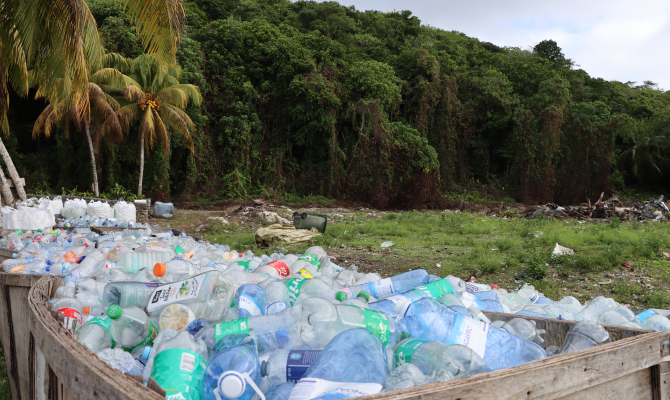
Big Ocean States didn’t design the packaging that washes onto their reefs. They’re ready to lead the clean-up, if the world helps pay for it.
Every week, ships arrive in Fiji carrying everything from pasta to car parts. The packaging stays. And when the next cyclone tears through, much of it ends up where island waste often goes, into the sea.
That is the reality Pacific leaders brought to the Ocean Pavilion at COP31, in a Zero Waste in Big Ocean States, side event.
One crisis, not three.
Hon. Lynda Tabuya, Minister for Environment and Climate Change in Fiji opened the session by saying “We are not small island states, but big ocean states.” Fiji’s ocean alone is roughly seventy times the size of its land.
“For big ocean states, the triple planetary crisis is not three crises. It is one,” she said. Waste mismanaged on land flows down rivers, onto reefs and into fisheries, and landfill methane makes waste responsible for close to a tenth of Fiji’s greenhouse gas emissions.
Fiji has banned polystyrene, restricted single-use plastic bags and substantially raised littering fines. But Hon. Tabuya was realistic about the limits. Fiji imports most of its plastics with little say over their design, shipping is costly, and volumes are too small for recycling markets to work alone.
She asked that producers be made responsible for what they ship to islands, treat moving recyclables off islands, and finance methane first.
“We are not asking to be rescued from our geography. We are asking to be financed for our stewardship,” she added.
According to SPREP’s State of the Environment and Conservation in the Pacific Islands: 2020 Regional Report, the regional average of waste per person is 1.2 kg per person per day. Tourism, imported goods and debris from diasters contribute heavily to waste in the Pacific.
Mr Sefanaia Nawadra, SPREP’s Director General highlighted one workaround already in motion. Under the Moana Taka Partnership, Swire Shipping fills containers that would otherwise travel back empty with recyclables, carrying them to bigger markets at its own cost.
However, someone still has to cover costs on shore and guarantee the material reaches a recycler. This is where national recycling associations come in.
In September, at the Pacific Forum Leaders meeting in Palau, agreed to develop a Regional Extended Producer Responsibility framework to put more of that burden on producers. DG Nawadra said “Tailored to national contexts, this policy will compel private sector accountability across targeted packaging and material streams.”
Palau as an example
Hon. Steven Victor , Minister of Agriculture, Fisheries and Environment remembers when a banana peel or fish bone thrown on the ground simply went back to the earth. “Plastics do not disappear,” he told a Pre-COP event in Nadi last month. Palau has a container deposit scheme since 2011 where shoppers pay 10 cents a container and get five cents in return.
“Financial sustainability is important. You cannot just build a facility and hope,” he said.
In the capital Koror, the recycling centre turns food scraps into compost, plastic into fuel and bottles into art and jewellery.
Hon. Minister Victor said much of the plastic isn’t from Palau. “It came through the ocean current with somebody else’s waste.” He described machines that compact plastic to save shipping space, even clothing made from recycled fibre.
Hon. Hiroyoshi Sasagawa, Minister of Environment from Japan was in agreement. With limited land and markets, managing waste within a single island is difficult, he said. Japan, through the Japanese Technical Cooperation Project for Promotion of Regional Initiative on Solid Waste Management in Pacific Island Countries (J-PRISM), links hard-to-recycle materials with facilities abroad.
“The ocean does not separate the islands, it connects them,” he added.
Ms. Khadija Stewart, Trinidad and Tobago youth representative brought the Caribbean into the conversation. While on a youth exchange, she visited a coastal community where waste was being used to compact land against rising seas.
Hon. Victor related to that. He had described it in previous presentations where high tide in Palau can now swallow a dock and creep across a parking lot.
In her closing remarks, Ms. Stewart pleaded for young entrepreneurs, scientists and policymakers to remove the old extract-and-discard model instead of repeating it. And she borrowed Fiji’s phrase - “We are big ocean states.”
The road to PALM11
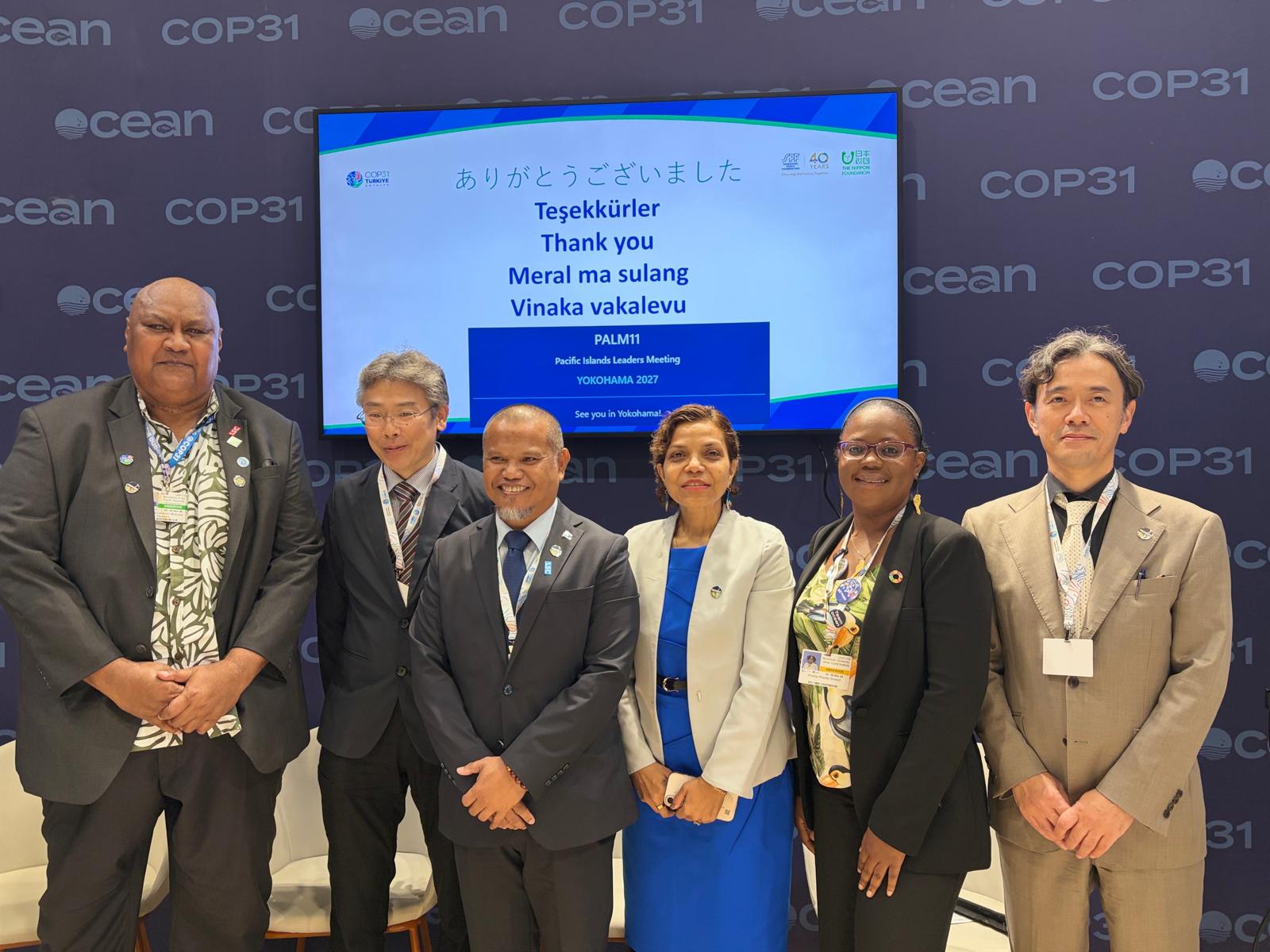
The panel’s shared conclusion was that islands cannot wait for a plastics treaty. Palau knows those talks well. It has long pressed for a treaty that curbs production rather than leaning on recycling, and Hon. Victor spoke for small island states in Geneva as AOSIS Chair. He closed the session by pointing to PALM11, the next Pacific Islands Leaders Meeting with Japan, to carry this conversation forward.
“We have spent years bringing the ocean into the conversation. Now we must bring the results of that conversation back to the ocean.”
Held on 18th November 2026, the Zero Waste in Big Ocean Statesside event was held at the WHO Health Pavilion.
The 31st Conference of the Parties (COP31) to the UN Framework Convention on Climate Change (UNFCCC) is taking place from 9-20 November 2026 in Antalya, Türkiye.
The Pacific Islands Parties to the UNFCCC are Cook Islands, Federated States of Micronesia, Fiji, Kiribati, Republic of Marshall Islands, Republic of Naoero, Niue, Palau, Papua New Guinea, Samoa, Solomon Islands, Tonga, Tuvalu and Vanuatu.